Backlog strategy: 5 practical moves to turn tickets into outcomes

Your team closed 43 tickets last sprint. Yet somehow, the product still feels stuck. Sound familiar? This paradox haunts development teams everywhere: plenty of motion, but little meaningful progress.
The problem isn't a lack of effort, it's a lack of direction. Most backlogs have evolved into glorified dumping grounds where requests accumulate faster than anyone can process them. Tickets multiply, priorities blur, and the connection between daily work and actual business impact vanishes. Teams find themselves perpetually busy yet chronically unsure whether they're building the right things.
A strong backlog strategy transforms this chaos. Rather than managing an endless to-do list, you create a value engine that converts team capacity into measurable outcomes. The shift requires intentional structure, regular maintenance, and clear ties between execution and strategy.
This article walks through five practical moves that help development teams escape ticket hell. These aren't abstract frameworks; they're tactical approaches you can implement this week to start turning tasks into genuine business results.
What makes a weak backlog
Before fixing your backlog, you need to recognize the symptoms of dysfunction. Most struggling teams share similar patterns that signal the absence of a coherent backlog strategy.
Outdated inventory dominates the view. Scroll through your backlog and you'll find feature requests from two years ago, bug reports for deprecated code, and "someday maybe" ideas that nobody remembers submitting. These zombie tickets clog the system and create noise that obscures what actually matters.
Ownership remains perpetually unclear. Who's responsible for that API integration ticket? The answer is usually "nobody specific," which in practice means nobody at all. Without clear ownership, tickets drift in limbo - too important to delete, too ambiguous to start.
Prioritization often relies on intuition, not data. Teams default to squeaky-wheel prioritization - whoever complains loudest gets handled first. This reactive approach prevents focus on high-leverage work.
Business goals live in a separate universe. The product roadmap sits in leadership slide decks while developers work from an issue tracker. These two worlds rarely intersect. Engineers complete tickets without understanding how their work connects to revenue, retention, or strategic initiatives. Such a disconnect doesn’t just waste effort - it kills motivation.
Backlog To Outcomes Playbook: Five Practical Moves And Acceptance Criteria Templates
Enter your email address to get a comprehensive, step-by-step guide

5 actionable strategies to turn tickets into outcomes
1. Define clear outcome statements
Task-oriented thinking breeds busywork. "Implement user authentication" describes an activity but sidesteps the fundamental question: why does this matter? Turning tasks into value starts with reframing how you describe work.
Replace task descriptions with outcome statements that specify the desired result. Instead of "Add filter functionality to dashboard," write "Enable sales managers to identify at-risk accounts in under 30 seconds so they can intervene before churn." The difference is profound. One describes what you'll build; the other explains what success looks like.
Crafting strong outcome statements requires answering three questions for each backlog item:
- Who benefits from this change? Get specific. "Users" is too vague. "Marketing managers running paid campaigns" creates clarity about whose problem you're solving.
- What capability or improvement do they gain? Describe the functional improvement in user terms, not technical specifications. Focus on what becomes possible that wasn't before.
- How will we measure success? Identify the metric that indicates value delivery. This might be time saved, error reduction, conversion lift, or engagement increase.
This approach fundamentally changes backlog prioritization. When every item clearly articulates its expected impact, you can compare apples to apples. A ticket promising 15% faster report generation can be weighed against one targeting 8% reduction in onboarding dropoff.
Start by revising your top ten backlog items. For each, add an outcome statement following the format: "[user segment] can [capability] so that [business metric improves]." You'll immediately spot items that struggle to articulate clear value - those are prime candidates for deprioritization or removal.

2. Create a "Now-Next-Later" view
Traditional backlogs present an overwhelming wall of tickets. The cognitive load alone paralyzes decision-making. Teams need a simpler mental model for delivery focus.
The Now-Next-Later framework slashes complexity by collapsing your backlog into three time horizons:
- Now represents active work - what your team is building this sprint or month. This bucket stays deliberately small, typically 3-8 items depending on team size. The constraint forces genuine prioritization.
- Next contains fully refined work that's queue-ready. These items have clear requirements, defined acceptance criteria, and resolved dependencies. Keep this list to roughly twice your Now capacity.
- Later encompasses everything else - ideas worth exploring, requests under consideration, and possibilities for future quarters. This bucket operates as a parking lot that acknowledges requests without committing to them.
The power of this model lies in its simplicity. Team members can instantly understand current priorities without parsing through hundreds of tickets. Stakeholders get transparency into what's happening now, what's coming soon, and what's being considered.
Use visual board columns or tags to operationalize this framework. In Bitrix24 or similar project management platforms, create three master categories that organize all work. Review and update these groupings weekly, promoting items from Later to Next once they're refined, and from Next to Now when capacity opens.
This structure also improves sprint planning tactics. Rather than starting each sprint by sifting through the entire backlog, you're selecting from a pre-qualified Next list where every item is already vetted and ready to begin. Building this visualization represents a foundational element of any effective backlog strategy.
3. Apply ruthless triage
Backlogs naturally accumulate cruft. Every request that gets logged adds another ticket. Without active pruning, the backlog becomes a cemetery of outdated ideas.
Ticket refinement isn't just about elaborating requirements; it's also about removal. Schedule quarterly backlog triage sessions dedicated entirely to deletion and consolidation. An effective backlog strategy treats removal as seriously as addition.
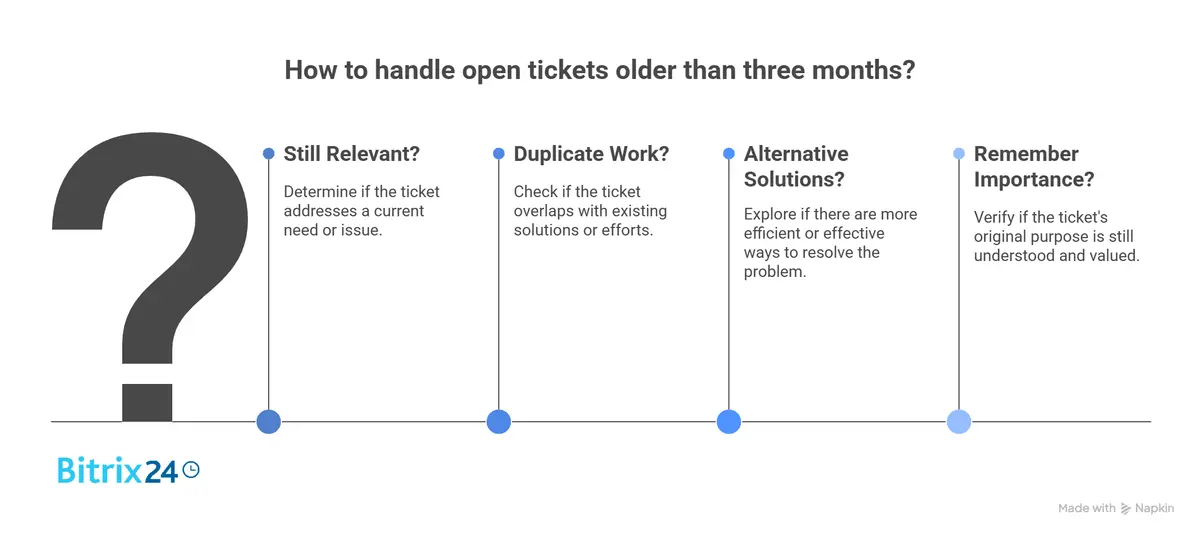
During triage, examine every ticket that's been open longer than three months and ask:
Is this still relevant? Product priorities shift, business conditions change, and strategic direction evolves. A feature request that made perfect sense last year might be completely misaligned with current goals.
Does this duplicate existing work? Teams often file the same request multiple ways. Merge duplicates aggressively and consolidate conversations.
Can we solve the underlying problem differently? Some tickets persist because they represent real user pain but propose the wrong solution. Challenge whether you need to build what's requested or if an alternative approach addresses the core need more efficiently.
Does anyone remember why this matters? If you can't reconstruct the business case for a ticket, it probably doesn't have one.
Set aggressive deletion targets for triage sessions to ensure efficient management. Aim to eliminate or consolidate 30-40% of items that have lingered for months. Keeping low-value work visible creates the illusion that it might get built, which sets false expectations and clutters decisions.
4. Establish decision rituals
Backlogs decay without regular maintenance. What starts as a clean, prioritized list gradually devolves as new requests arrive and circumstances change. The solution isn't harder work. It demands consistent rituals that prevent entropy.
Build two regular ceremonies into your team rhythm:
- Weekly mini-refinements (30 minutes) keep upcoming work ready. Gather your core delivery team and review the Next bucket. For each item in Next, verify that acceptance criteria are defined, dependencies are identified, rough effort estimates exist, and questions blocking work have answers.
This session operates as quality control, catching gaps before they delay sprints. If an item lacks clarity, either resolve it on the spot or move it back to Later until someone can provide missing information.
- Monthly re-prioritizations (60-90 minutes) realign the backlog with evolving strategy. Include both delivery leads and product stakeholders. Review the entire Now-Next-Later structure and ask: Have business priorities shifted? What did we learn from recently shipped work? Which assumptions have proven wrong?
Use this session to aggressively reorder, move items between buckets, and archive anything that no longer serves current objectives. Your backlog strategy must adapt as conditions change.
These rituals create crucial developer alignment. Regular touchpoints ensure engineers understand why priorities shift and how their work connects to broader goals. The predictability also reduces frustration - teams know when prioritization conversations happen rather than facing constant ad-hoc disruptions.
Document decisions and rationale in each ticket. When priorities change, note why. This practice prevents the relitigation of settled questions and builds institutional knowledge.
5. Connect roadmap and backlog
Strategy and execution often live in parallel universes. The roadmap highlights big quarterly themes while the backlog lists granular tickets with vague ties to those themes.
The resulting disconnect breeds confusion and waste. Engineers ship tickets without understanding their strategic value, and planning breaks down because the map doesn't match the terrain.
Close the gap by explicitly linking strategic initiatives to backlog items. That alignment forms the backbone of a mature backlog strategy that keeps teams focused on what matters.
- Structure your backlog hierarchically. Use epics or initiatives as containers that group related tickets under strategic themes. If your Q2 roadmap includes "Improve enterprise customer retention," create a corresponding epic in your backlog. Every ticket contributing to retention should nest under this epic.
- Ensure every epic has a success metric. Just as individual tickets need outcome statements, initiatives need measurable objectives. "Improve retention" is a directional but vague term. "Reduce enterprise customer churn from 12% to 8% by August" creates accountability. These metrics become your agile outcomes - the results that determine whether strategic bets paid off.
- Map every active ticket to a strategic initiative. No orphans allowed. If a ticket can't be traced to a current roadmap theme, question whether it belongs in Now or Next. This doesn't mean you can't address urgent bugs or technical debt -it means those categories should exist explicitly on your roadmap.
- Review alignment monthly. During your re-prioritization ritual, audit whether your backlog distribution matches strategic priorities. If the roadmap claims retention is the top focus, but only 20% of backlog items relate to retention, you have a misalignment problem.
Connecting roadmap and backlog transforms your backlog from a task list into a results-driven system. Instead of asking “Are we completing tickets?” ask “Are we achieving the outcomes those tickets promised?”
Getting started with tasks & projects
Enter your email to download a guide that will get you started with any project management software.

Team alignment tools that make strategy visible
Having a strong backlog strategy means little if the team can't see it in action. Visual alignment tools bridge the gap between planning and execution, making priorities tangible and progress transparent.
Kanban boards provide the simplest starting point. Columns representing Now, Next, and Later give everyone a shared view of work status. Cards moving across the board create a rhythm of progress that's immediately visible.
Task management platforms like Bitrix24 add structure beyond basic boards. You can establish custom workflows that match your team's process, set dependencies between items, and automate status updates. The ability to comment directly on tasks keeps context centralized. Integrated time tracking reveals whether effort distribution aligns with stated priorities.
OKR dashboards connect backlog work to business objectives. These tools visualize how completed tickets contribute to key results, making the strategy-execution link explicit. When engineers complete a feature, they see the corresponding key result update.
The specific tools matter less than the principles they enable: shared visibility ensures everyone sees the same picture, real-time updates keep information current, clear ownership tags every item with responsible parties, and progress metrics quantify velocity.
Bitrix24 consolidates many of these capabilities in one platform: task boards with custom workflows, integrated communication, time tracking, and goal visualization. This consolidation reduces context switching and keeps alignment information centralized.
Backlog excellence that drives real results
Most teams already know their backlog needs work. They feel the frustration of unclear priorities, the inefficiency of scattered effort, and the disconnect between busy schedules and meaningful progress. Yet backlogs remain broken because fixing them feels overwhelming.
Start smaller. Don't attempt overhauling your entire backlog next week. Pick one of the five moves described here and implement it immediately. Rewrite your top five tickets as outcome statements. Transform task descriptions into value statements that articulate expected impact.
The beauty of these strategies is their compounding nature. Each improvement makes the next easier. Clearer outcomes enable better prioritization. Better prioritization reduces backlog bloat. A leaner backlog needs less maintenance.
A strong backlog strategy doesn't guarantee success, but it removes a major obstacle. Teams with healthy backlogs spend less time arguing about what to build and more time actually building. They ship with confidence because they understand how their work connects to business goals.
The path from ticket chaos to outcome focus isn't mysterious. It requires consistent application of straightforward principles. Audit your current backlog this week. Identify which of the five moves would yield the biggest immediate improvement. Then implement it. Whether you're establishing rituals for the first time or refining an existing backlog strategy, small consistent changes produce remarkable results over time.
Effective backlog grooming, paired with the right platform, amplifies these gains. Tools like Bitrix24 make alignment visible, keep collaboration seamless, and render progress measurable. When execution and planning move in sync, teams finally escape the paradox of being perpetually busy yet rarely effective.
Bitrix24 unites backlog practice, automation, and collaboration in one workspace by combining structure with workflow rigor.
Its Kanban-style boards map the Now-Next-Later flow, providing instant visibility into priorities and progress. Custom workflows and automation rules orchestrate refinement, approvals, and recurring maintenance tasks, cutting manual overhead. Integrated goal/OKR dashboards and analytics tie backlog work directly to measurable outcomes, rendering performance visible across the organization. Its AI-powered assistant summarizes discussions, proposes next actions, and aligns tasks with goals - ideal for keeping the backlog clean and focused.
Workload management and time tracking maintain balanced capacity, while task dependencies and Gantt charts clarify project sequencing. Built-in communication, comments, and document sharing consolidate collaboration , removing silos between product, design, and engineering.
Combined with access controls and detailed activity logs, Bitrix24 delivers the clarity, accountability, and data insight needed to sustain a truly outcome-driven backlog.
Ready to unlock a better way for your team to turn work into results? Create your free Bitrix24 account and start building a backlog that drives real outcomes instead of just processing tickets.
Simplify project management with Bitrix24!
Organize tasks, track work progress, and collaborate effortlessly – all in one platform. Free forever, unlimited users.
GET BITRIX24 FOR FREEFAQs
What is a backlog strategy?
A backlog strategy is a systematic approach that defines how your team organizes, prioritizes, and maintains work items to maximize business impact. Rather than treating the backlog as a simple task list, this strategy establishes principles for what gets added, how priorities get set, how often items get reviewed, and how work connects to strategic objectives. It transforms the backlog from a dumping ground into a value engine.
How do I turn tasks into outcomes?
To turn tasks into outcomes, start by reframing tickets to specify desired results rather than activities. Replace "build feature X" with statements that identify who benefits, what capability they gain, and how success will be measured. For example, transform "add export function" into "enable analysts to extract report data in under 10 seconds so they can create executive summaries faster." This shift makes impact assessment straightforward and focuses teams on business value.
How do you prioritize a chaotic backlog?
To prioritize a chaotic backlog, begin with ruthless triage: archive or delete items older than three months that no longer support current goals. Then implement a Now-Next-Later framework to collapse complexity into three clear buckets. Focus on filling "Now" with only the highest-impact work your team can complete this sprint. Establish weekly refinement and monthly re-prioritization rituals to prevent decay. Prioritization becomes manageable when you reduce noise and create regular decision points.