Retainer Management for Agencies: 5 Systems to Keep Delivery and Client Updates Without Gaps


Retainer work doesn’t usually break because of poor delivery. It breaks in the gaps between tools, teams, and client communication.
A client sends a polite but pointed email asking where things stand. The account manager has to check three different tools. The project lead says the work shipped last week. The client says they never saw it. Nobody is lying - the system just never connected the dots between "done" and "delivered." This is not an isolated incident, but a structural problem. The failure sits between execution and visibility, not in the work itself. This gap is exactly what retainer management is meant to solve.
Retainer management for agencies focuses on organizing recurring client work into repeatable systems that connect sales, delivery, and communication under one roof. It applies to digital marketing firms, creative studios, development shops, and any service business that bills clients on a monthly or quarterly cycle. When it works, retainers become your most predictable revenue stream. When it breaks, you lose clients not because of bad work, but because nobody could see what was happening.
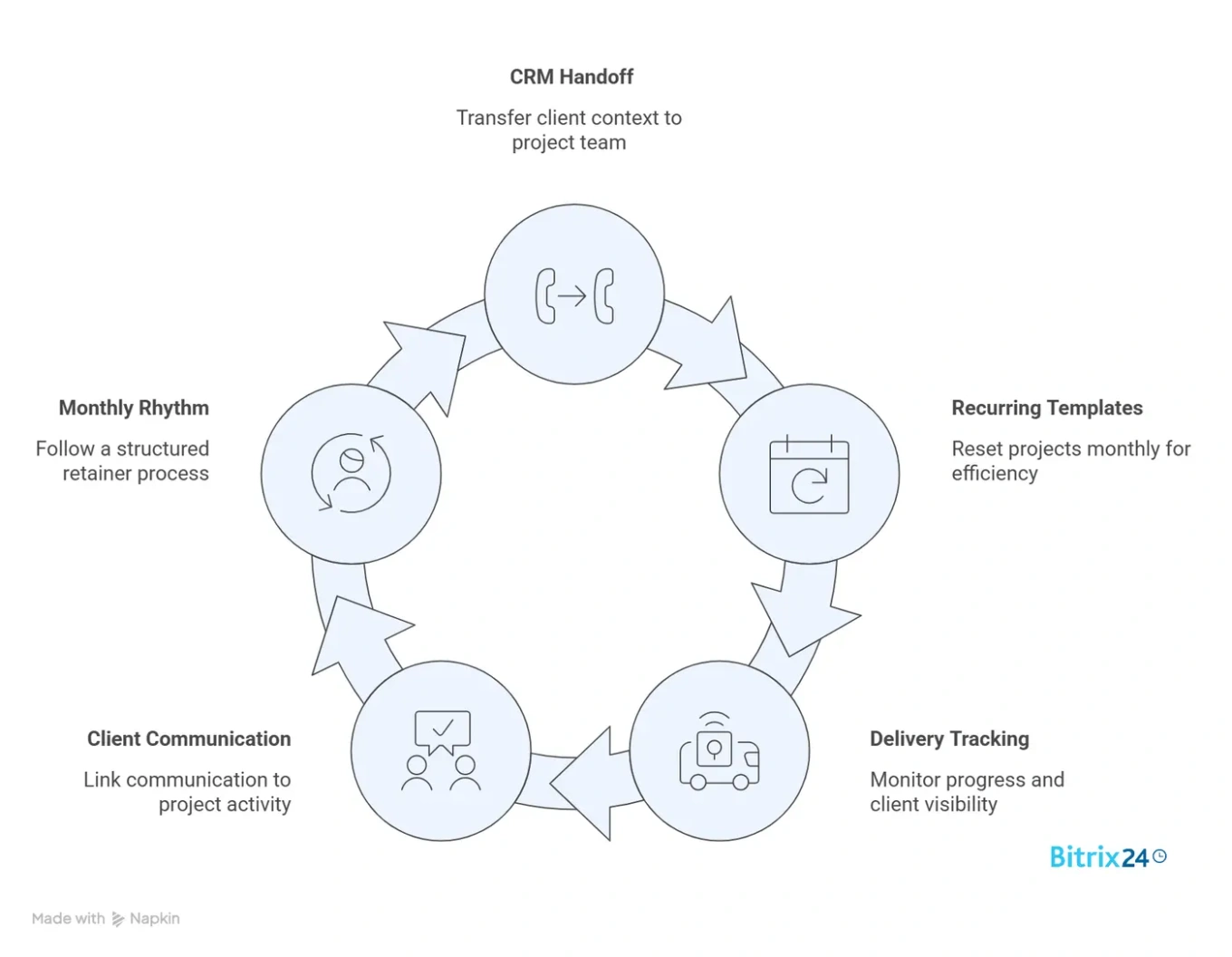
This article walks through five systems that agencies use to keep retainer management from falling apart - covering the pipeline-to-project handoff, delivery tracking, client communication, and the monthly rhythm that ties it all together.
Why Agency Retainers Fall Apart (and It's Rarely About the Work)
Most agencies don't lose retainer clients because the output was bad. They lose them because of invisible gaps between teams, tools, and timelines.
Three patterns show up repeatedly:
- Delivery gaps nobody notices. A task gets marked complete in the project tool, but the client never receives the deliverable. The agency assumes the client is happy. The client assumes the agency forgot. By the time someone speaks up, trust is already damaged.
- Client silence that gets misread. When a retainer client goes quiet, account managers often read it as satisfaction. More often, it means the client stopped expecting proactive updates and started shopping for a replacement. Retainer client management requires regular touchpoints - not just when something goes wrong.
- Scope creep without documentation. Small requests pile up across Slack messages, emails, and calls. Nobody tracks the cumulative hours. Three months later, the agency realizes they're doing 40% more work than the contract covers, and the client thinks everything was included.
Each of these problems is a systems failure, not a people failure. The fix is structural: connect your pipeline, your project templates, and your client communication into a single workflow. That's what the five systems below are designed to do.
System 1: CRM-to-Project Handoff That Preserves Client Context
The first breakdown in any agency retainer workflow happens at the handoff between sales and delivery. A deal closes in the CRM, and then someone manually creates a project, re-enters the client's requirements, and hopes nothing gets lost in translation.
A proper handoff system works differently. When a retainer deal moves to "won" in your agency CRM pipeline, the project should spin up automatically - pre-loaded with the scope, deliverables, and timeline that were agreed during the sales process. The delivery team shouldn't need to ask "what did we promise?" That information should already be sitting in the project brief.
What makes this work in practice:
- Deal fields in the CRM map directly to project parameters (scope, monthly hours, deliverable types, reporting cadence)
- A project template triggers on deal close, creating the task structure, assigning roles, and setting initial deadlines
- The account manager's notes from the sales process transfer into the project workspace, so the delivery team has full context
This CRM-to-project connection matters more for retainers than for one-off projects. A single project forgives a sloppy handoff because you figure things out as you go. Retainer management for agencies requires getting the setup right from the start, because that template repeats month after month.
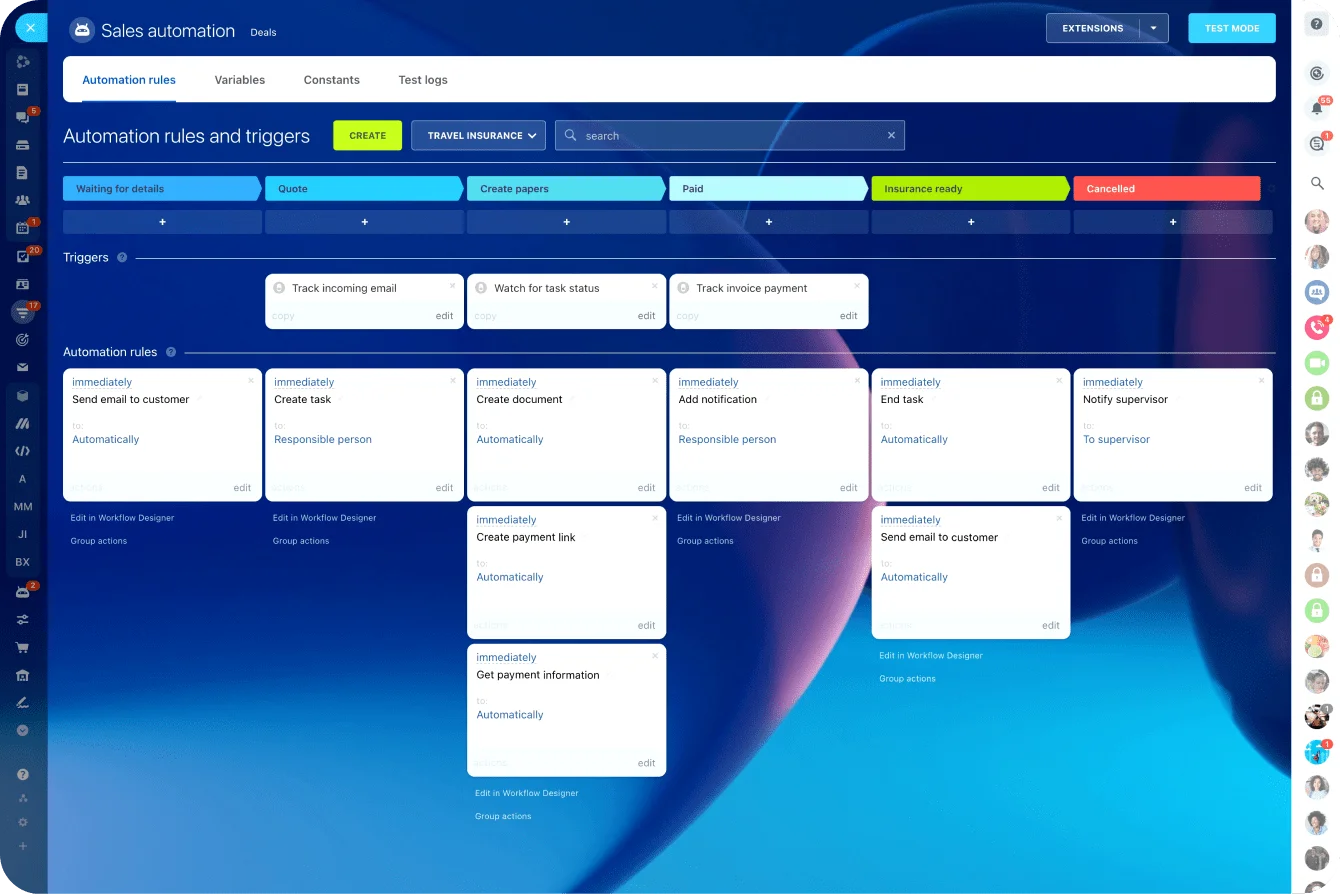
Bitrix24's CRM supports this kind of automation natively. When a deal reaches a specific stage, you can trigger project creation from a template, carry over custom fields, and assign the delivery team - removing manual data transfer from spreadsheets.
System 2: Recurring Project Templates That Reset Monthly
One-off project management and recurring client project management require different thinking. A one-off project has a beginning, a middle, and an end. A retainer has a rhythm - the same categories of work, repeated on a cycle, with variations each month.
The second system agencies need is a set of project templates that can be cloned and customized for each retainer cycle. Think of it like a franchise playbook: the structure stays consistent, but the details change with each iteration.
A solid monthly retainer tracking system includes templates with:
- Pre-built task groups for each deliverable category (content, design, reporting, strategy)
- Default assignees and estimated hours already filled in
- Dependency chains so tasks trigger in the right order
- A built-in checkpoint for client approval before moving to the next phase
Without templates, project managers rebuild the same structure from scratch every month. That wastes time, introduces inconsistency, and makes it harder to compare performance across months. Solid retainer management for agencies depends on this kind of repeatable scaffolding - templates let the team focus on executing the work instead of organizing it.
Bitrix24's task and project management tools let you build reusable project templates with task dependencies, checklists, and role assignments. When a new retainer cycle begins, you clone the template, adjust the specifics, and the team is ready to move on day one.
Agency Retainer Survival Kit: Where Time Leaks and Margins Disappear (Fix in 7 Days)
Enter your email address to get a comprehensive, step-by-step guide

System 3: Agency Delivery Tracking with Built-in Client Visibility
Here is where most agency workflows break down: the work gets done, but the client can't see it. Retainer management for agencies lives and dies on visibility - internal project boards track completion for the team, but clients are left refreshing their inbox waiting for an update that may or may not come.
Agency delivery tracking needs two layers. The internal layer shows your team what's in progress, what's blocked, and what's due. The external layer gives the client a view of completed deliverables, upcoming milestones, and any items waiting on their input.
Splitting these two layers matters because:
- Your team needs granular task-level detail (subtasks, internal comments, time logs) that would overwhelm a client
- Your client needs a clean summary: what's done, what's next, what they owe you
- Status updates shouldn't require a meeting or an email chain - the client should be able to check progress on their own schedule
Some agencies handle this with shared dashboards. Others use weekly automated reports. The approach depends on client preferences, but the principle is the same: if the client has to ask for a status update, the system has already failed.
This is also where retainer billing and delivery intersect. When you can show a client exactly what was delivered against their monthly retainer hours, billing conversations become straightforward instead of adversarial.

System 4: Client Communication Channels Tied to Project Activity
Email threads about retainer work are where context goes to die. A client sends feedback on a deliverable to the account manager. The account manager forwards it to the designer. The designer replies with questions. The account manager forgets to loop in the project lead. Two days later, everyone has a different version of what was agreed.
Retainer client communication works when the conversation lives next to the work. That means tying client messages, feedback, and approvals directly to the tasks or deliverables they reference.
Practical ways agencies set this up:
- A dedicated client channel or group chat connected to the project workspace, so conversations are searchable and tied to context
- Task-level commenting where the client can leave feedback directly on a deliverable, visible to the whole team
- Automated notifications when a task moves to "ready for review" or "approved," so nobody has to manually ping the client
Client account management software that separates communication from project management creates a gap. The conversation happens in one place, the work happens in another, and someone has to manually bridge the two. That bridge breaks under load - especially when an agency manages ten or fifteen retainers simultaneously. Any serious approach to retainer management for agencies needs communication and project tracking in the same tool.
Bitrix24's communication tools connect chat, video, and task comments in one workspace. Client-facing groups can be created alongside internal team channels, so the right people see the right conversations without cross-posting between platforms.
System 5: Monthly Retainer Rhythm - Intake, Delivery, Reporting
The first four systems are structural. This fifth one is operational - it's the cadence that keeps everything moving on time.
Agencies that run retainers well follow a monthly cycle with four distinct phases:
- Week 1 - Intake and planning. The account manager meets with the client (or reviews their brief) to confirm priorities for the month. Tasks are assigned within the project template. The delivery team reviews scope and flags anything unclear before starting.
- Weeks 2 and 3 - Execution and checkpoints. The team works through the task list. Mid-month check-ins catch problems early - a delayed approval from the client, a scope addition that needs documentation, or a resource conflict with another account. Agency project templates should include these checkpoint tasks by default.
- Week 4 - Delivery and reporting. Completed deliverables go to the client with a summary. A monthly report covers what was delivered, hours used, and recommended priorities for next month. This report isn't just paperwork - it's the document that justifies the retainer fee and sets expectations for the next cycle.
- Ongoing - Review and adjust. After three to six months, review the retainer scope against actual delivery. Are you consistently going over hours? Is the client asking for work outside the original agreement? Retainer management for agencies isn't static - the system needs periodic recalibration to stay profitable and keep the client relationship healthy.
This rhythm protects both sides. The client gets predictability and transparency. The agency gets structured delivery and documented scope.
When Retainer Management Systems Don't Solve the Problem
No system fixes a fundamentally misaligned retainer. There are situations where the tools and processes described above won't help:
- The retainer scope was never clearly defined. If the contract says "ongoing marketing support" without specifying deliverables, hours, or success metrics, no template or tracking system can fill that gap. The fix is contractual, not operational.
- The client expects on-demand work, not scheduled delivery. Some clients treat a retainer like an unlimited support ticket. They want things done the same day, regardless of the monthly plan. Retainer management for agencies assumes a planned cadence - if the client's needs are genuinely reactive, a different engagement model (like a block-hours arrangement) may be a better fit.
- The agency doesn't have enough capacity to serve the retainer. Overbooking retainers - saying yes to more monthly commitments than the team can handle - creates delivery failures that no project template can prevent.
Recognizing these edge cases early saves you from blaming the system when the real problem is upstream.

CRM Pipeline as the Backbone of Your Agency Retainer Workflow
Retainer management for agencies works best when the CRM isn't just a sales tool - it's the connective tissue between acquisition, delivery, and retention.
Your agency CRM pipeline should track retainer accounts through their full lifecycle: prospect, active, at-risk, and renewal. Each stage triggers different actions. An active retainer in good standing gets monthly reporting. An at-risk account (flagged by missed deliveries, declined meetings, or low engagement) gets a recovery plan. A renewal-stage account gets a scope review and a proposal for the next term.
This lifecycle view turns retainer management from a project-by-project exercise into a portfolio-level strategy. You stop managing individual tasks and start managing client relationships across your entire book of business.
Run Your Retainers Like a System, Not a Guessing Game
Agencies that treat retainers as "just ongoing projects" end up with the same problems: missed deliverables, silent clients, and scope that creeps beyond profitability. The five systems outlined here - CRM handoff, recurring templates, delivery tracking, integrated communication, and a monthly operational rhythm - create the structure that retainer management for agencies actually requires.
None of these systems need to be complicated. They need to be connected. When your pipeline, your project workspace, your client communication, and your reporting all live in the same platform, the gaps that kill retainers simply stop appearing.
Bitrix24 is an all-in-one platform where CRM, project management, team communication, and client-facing tools operate within a single workspace designed for this kind of connected workflow. What makes the difference in practice is how these pieces work together.
Deals in the CRM can trigger project creation automatically, carrying over scope, timelines, and context into delivery, eliminating manual handoff. Recurring project templates and task structures give each retainer a consistent monthly starting point, while Kanban boards and task tracking make progress visible both internally and, when needed, to the client.
Communication stays tied to the work through task comments, shared spaces, and integrated chat or video, so feedback, approvals, and updates don’t get lost across tools. At the same time, built-in automation rules can trigger notifications, status changes, or follow-ups based on real progress, keeping the system moving without constant supervision.
Instead of stitching together separate tools for sales, delivery, and reporting, everything runs in one place, which is exactly what retainer management for agencies requires to stay predictable and scalable.
If you're running retainers across multiple clients and tired of duct-taping tools together, sign up for Bitrix24 and see how a unified platform changes the way your agency delivers.
Operate Effortlessly with Bitrix24
Bitrix24 offers a unified platform where CRM, project management and team communication work as one. Simplify your agency processes and improve retainer management.
Get Started NowFAQ
What does retainer management mean for agencies?
Retainer management for agencies refers to the systems, processes, and tools that service businesses use to organize recurring client work into predictable, repeatable workflows. It covers everything from the initial CRM handoff when a retainer deal closes, through monthly delivery cycles, to client reporting and scope reviews. Agencies that manage retainers well connect their sales pipeline, project templates, delivery tracking, and client communication into one coordinated system.
How do you prevent scope creep on retainer accounts?
Preventing scope creep on retainer accounts starts with a clearly defined scope document that specifies deliverables, monthly hours, and what counts as out-of-scope work. From there, every client request should be logged against the retainer agreement. When requests exceed the agreed scope, the account manager documents the addition and discusses whether it warrants a retainer adjustment. Project templates with pre-set task groups help teams spot when work exceeds the planned structure.
What is the best way to track delivery across multiple retainer clients?
Tracking delivery across multiple retainer clients requires a centralized project management system where each client has a recurring project template. The best approach combines internal task tracking (for your team's day-to-day execution) with a client-facing summary layer that shows completed deliverables and upcoming milestones. Automated reports at the end of each month keep both the agency and the client aligned on what was delivered versus what was planned.
How often should agencies communicate with retainer clients?
Agencies should communicate with retainer clients at a minimum of three structured touchpoints per month: a planning session at the start of the cycle, a mid-month checkpoint, and a delivery summary with a monthly report. Beyond these scheduled interactions, a dedicated communication channel tied to the project workspace allows the client to ask questions and give feedback without waiting for the next meeting.
Can a CRM replace project management for retainer workflows?
A CRM alone cannot replace project management for retainer workflows. CRMs are designed to track deals, contacts, and sales pipelines - not manage task assignments, dependencies, and delivery timelines. The strongest retainer management setups use the CRM as the starting point (tracking the client relationship and triggering project creation) and hand off to project management tools for execution. Platforms like Bitrix24 combine both functions, which removes the gap between sales and delivery.
What should a monthly retainer report include?
A monthly retainer report should include a summary of all deliverables completed during the cycle, hours used versus hours allocated, any items that carried over to the next month, and recommended priorities going forward. The report serves two purposes: it documents the value the client received and it sets expectations for the upcoming cycle. Including a brief note on scope changes or additional requests helps keep the retainer agreement transparent and up to date.
When should an agency consider restructuring a retainer agreement?
An agency should consider restructuring a retainer agreement when delivery consistently exceeds the allocated hours for three or more consecutive months, when the client's business needs have shifted significantly from the original scope, or when the retainer is no longer profitable at the current rate. Quarterly scope reviews are a good practice for catching these signals early, before either side becomes frustrated with the arrangement.