Maximize Margin ROI: Strategies for Customer Retention


Retention only pays off when it improves profitable lifetime value, not recurring revenue on paper. A customer who renews for years while absorbing heavy support, repeated discounts, and constant firefighting can look healthy on a dashboard while quietly draining margin.
That’s why the better question is not “How do we keep more customers?” It’s “Which retention efforts grow lifetime value and contribution margin at the same time?” Keeping churn low is only the easy half. The real work is keeping and growing the right accounts at the right service cost.
Get that distinction right and the payoff compounds.
Research from Frederick Reichheld of Bain & Company, cited by Harvard Business Review, found that a 5% lift in retention can raise profits by 25% to 95%, and that acquiring a customer costs five to 25 times more than keeping one.
This article shows how to identify the accounts worth investing in, improve account economics, avoid common retention traps, and scale the model without raising cost-to-serve.
What Margin ROI means in customer retention
Margin ROI in retention is the return you get from keeping and expanding customers after accounting for the cost of serving them. That includes delivery, support volume, customer success coverage, implementation work, renewal discounts, incentives, and any extra effort needed to keep the account.
That matters because revenue alone can be misleading. Customer Lifetime Value (LTV) usually gets the headline, but it can overstate account value if it is based mainly on how long a customer stays or how much they pay. A long-retained customer is not automatically profitable if the account needs heavy support, repeated concessions, or expensive manual work to stay.
A more useful view combines LTV with gross margin, net revenue retention, cost-to-serve, and renewal effort. The question changes from “how much revenue will this account generate?” to “how much profitable return will this account create relative to the work needed to keep and grow it?”
|
Metric |
What it measures |
What it misses on its own |
Why margin-aware teams care |
|---|---|---|---|
|
Customer retention rate |
Percentage of customers that stay |
Revenue quality, account size, service burden |
Shows logo preservation, not account profitability |
|
Revenue retention |
Percentage of recurring revenue retained |
Cost to deliver that revenue |
Useful for growth visibility, incomplete for margin |
|
LTV |
Expected value of a customer over time |
Can overstate value if based on top-line revenue |
Needs margin and servicing context to be actionable |
|
Margin ROI |
Return from retention and expansion after related costs |
Requires clean cost and account data |
Connects retention work directly to profit impact |
Margin ROI turns retention from a customer metric into a business metric. It helps sales and customer success decide where high-touch effort earns its keep, where automation is enough, and where expansion makes financial sense.
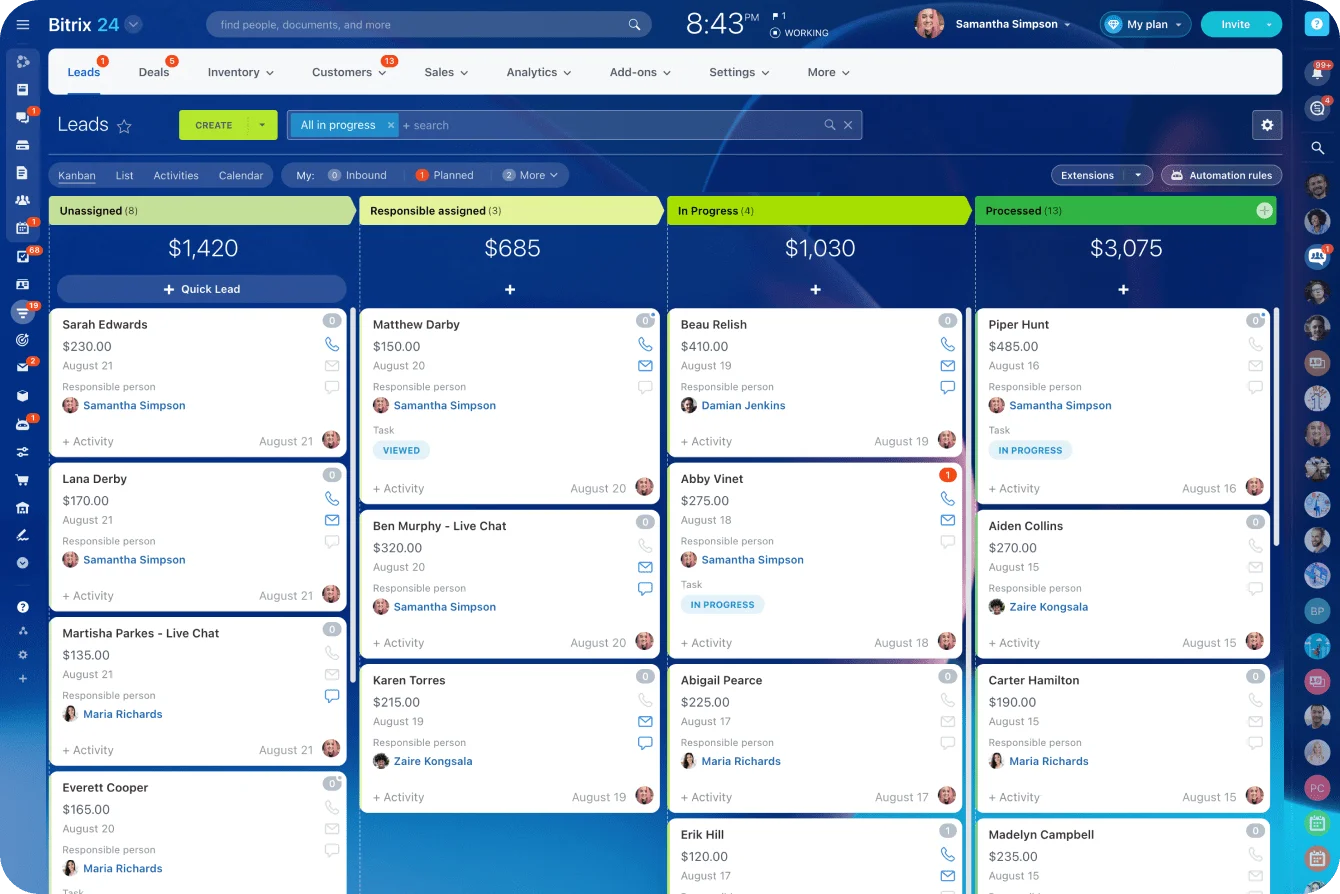
The challenge is that the data often sits in different places: contract value in the CRM, support volume in the service desk, product usage in the product platform, and renewal history in account notes or spreadsheets. When teams bring deal value, renewal history, customer activity, and reporting together in a CRM like Bitrix24, they can segment accounts by profitability instead of relying on revenue alone.
Why maximizing margin ROI matters for sales, customer success, and profit growth
Retention is usually more efficient than net-new acquisition because you already have the contract, relationship, product history, and account context. Renewals and expansions should cost less than winning new customers from scratch, and the Pacific Crest SaaS benchmarking survey found that acquiring a dollar of upsell revenue costs about a quarter as much as acquiring a dollar from a new customer.
But efficiency only turns into profit when the account economics work. The biggest gains come from retaining and growing the right accounts at the right service cost, not from treating every retained dollar as equally valuable.
Sharper expansion targeting for sales
For sales teams, margin awareness narrows the target list.
Instead of working every upsell path, a rep can focus on accounts with clear adoption momentum, a fit for higher tiers, and economics that justify the effort. Expansion gets more predictable and less dependent on last-minute discounting.
Smarter coverage for customer success
For customer success, it creates a better prioritization model.
A strategic account with strong fit and room to grow may earn proactive executive reviews, an adoption plan, and tailored renewal handling. A smaller, low-margin account with limited upside is often better served through digital programs, standard support paths, and clearer boundaries.
This is the daily call a CS lead makes when planning the team's week, and it's far easier when account health and revenue data live together in a CRM rather than scattered across spreadsheets.
Easier to defend, easier to forecast
Margin-aware retention also holds up when budgets tighten. Under pressure, retention programs get judged by visible activity rather than business effect. Tying account work to sustainable profit, not renewal volume or customer sentiment, makes the program defensible in a planning review.
Forecasting gets cleaner too. When teams know which retained accounts are healthy on both revenue and margin, they can separate dependable recurring growth from revenue that's fragile, concession-driven, or operationally expensive. That separation is easier to see when deal value, stage, and close dates roll up in one place, which is what sales pipeline management is built to do. The plan gets more honest.
A working rule of thumb: the best retention strategy keeps and grows customers whose long-term value exceeds the cost and complexity of serving them, which is a narrower goal than keeping as many customers as possible.
Customer Retention Profit Calculator: LTV, CAC, Margin Spreadsheet
Enter your email address to get a comprehensive, step-by-step guide

How customer retention increases LTV and margin ROI
From longer duration to deeper value
Retention drives profitability through a chain of effects, not a single event. When a customer stays longer, expected lifetime revenue rises. That's the obvious part. Less obvious is everything that happens around the relationship over time: lower reacquisition pressure, more room for expansion, deeper product familiarity, and smoother service.
If the customer also adopts the product deeply, value realization improves. Deep adoption lowers renewal risk because the product becomes embedded in daily work. It also raises willingness to buy more, additional modules, seats, service packages, or higher tiers.
Now LTV grows from both duration and account size.
Why revenue quality decides the payoff
Margin ROI rises when that extra value arrives with healthy economics: customers renew without heavy price erosion, use features that carry strong gross margins, and need less reactive support because onboarding was handled well early. The size of this effect is easy to underestimate. As SaaS Mag illustrates, two companies starting at $10M ARR, one at 120% net revenue retention and one at 95%, end up about $15M apart after three years from retention dynamics alone. The same analysis notes the median SMB-focused SaaS product sits near 97% NRR, meaning the typical account base is shrinking before a single new logo is added.
Predictability matters as well. Recurring revenue from stable, well-adopted customers gives the business cleaner planning visibility and reduces the quarterly pressure to replace churn with expensive new acquisition. Over time, that lowers commercial strain across the whole organization.
|
Retention driver |
LTV effect |
Margin impact |
|---|---|---|
|
Longer customer duration |
More revenue over time |
Spreads acquisition cost over a longer period |
|
Better product adoption |
Higher renewal likelihood |
Lower support friction, stronger pricing resilience |
|
Upsell and cross-sell fit |
Higher account value |
Improves gross margin if expansion products scale well |
|
Reduced churn pressure |
Less revenue replacement needed |
Cuts reliance on costly acquisition to stay flat |
|
Predictable recurring revenue |
More stable LTV expectations |
Supports cleaner planning and resource allocation |
What makes retention financially powerful is the set of conditions around each renewal. When those conditions build durable value and hold service and commercial costs in check, the economics compound. A renewal on its own guarantees none of that.
Core retention levers that improve account economics
Some levers improve both loyalty and account quality. Others protect revenue short term while weakening economics. The difference usually comes down to whether the tactic creates real customer value or just buys time.
Build value before the renewal
Onboarding quality may be the highest-impact lever, because it sets time-to-value. When customers reach a useful outcome quickly, adoption deepens and support friction drops, which builds a healthier base for the renewal and the first expansion. A SaaS team that ships a guided onboarding flow and a 30-day activation checklist will usually see fewer "how do I" tickets six months later than a team that hands over a login and a help-center URL.
Stakeholder alignment protects the account a different way. When operational users and an executive sponsor both understand the value case, the account survives personnel changes, budget reviews, and political drift. Retention gets less fragile. The common failure here is a deal anchored to one champion who then leaves.
Protect margin while you grow
Pricing discipline and renewal strategy are underrated. Teams that reach for a discount every time an account wobbles may save the revenue, but they train customers to negotiate late and hard, and they compress margin on every future renewal. Tying renewal to demonstrated value and clear packaging holds up better.
Expansion fit matters too. Selling a customer something they can realistically adopt is a world away from forcing add-ons to hit a quarterly number. One raises LTV. The other creates future churn and extra service burden.
|
Retention lever |
Effect on churn risk |
Effect on expansion potential |
Effect on cost-to-serve |
Likely impact on margin ROI |
|---|---|---|---|---|
|
Strong onboarding |
Lowers early churn |
Improves future readiness |
Reduces reactive support |
High positive |
|
Faster time-to-value |
Builds renewal confidence |
Creates trust for growth |
Shortens intervention cycles |
High positive |
|
Deep product adoption |
Stabilizes the account |
Opens upsell paths |
Often lowers issue volume |
High positive |
|
Stakeholder alignment |
Reduces political churn |
Supports broader buying |
Neutral to moderate reduction |
Positive |
|
Pricing discipline |
May raise some short-term risk |
Keeps expansion quality high |
Neutral |
Positive if value is clear |
|
Targeted success segmentation |
Improves resource focus |
Prioritizes best-fit accounts |
Controls over-servicing |
High positive |
|
High-touch save motions for everyone |
Cuts churn temporarily |
Usually limited |
Raises cost sharply |
Often negative |
As you can see, one operational truth runs through the table: the best retention systems improve customer outcomes selectively, where the economics justify the effort, instead of simply adding touchpoints. For the accounts that don't warrant a named manager, task and workflow automation handles the repeatable parts, onboarding sequences, renewal reminders, check-in cadences, so the human time goes where it changes the number.

Common mistakes that reduce retention ROI
The most common mistake is treating every customer as equally valuable. It sounds customer-friendly, sure. Operationally? It's a mess. Teams overinvest in low-margin or low-fit accounts while strategic customers get generic treatment, and the result is poor resource allocation, weak expansion capture, and avoidable margin leakage.
A second mistake is assuming discounts, custom terms, or service exceptions naturally build loyalty. Sometimes they do save a renewal. More often, they compress margin while the real problem (weak adoption, unclear value, bad fit) sits untouched.
If account health doesn't improve, the business is just paying more to postpone the same outcome.
Measuring motion instead of outcomes
There's also a measurement problem. Teams count activity because activity is easy to count: meetings held, emails sent, QBRs completed, touchpoints logged. Useful as operational indicators, but they aren't retention outcomes. A busy team isn't necessarily an effective one.
Better signals are renewal quality, product utilization, expansion efficiency, support burden, and profitability by segment. Those reveal whether account work is building durable value or just generating motion.
The same trap shows up in headline retention metrics: a healthy-looking net revenue retention number can hide serious churn that a few large expansions are masking, which is why gross retention and NRR need to be read together.
Weak assumptions tend to take three forms:
- Assuming a retained logo equals a healthy account: It can still be unprofitable, shrinking, or one champion away from leaving.
- Assuming more human attention always improves economics: Past a point, extra coverage just raises cost-to-serve without moving renewal odds.
- Assuming expansion is always worth it: Added revenue that's hard to deliver profitably creates tomorrow's margin problem.
These mistakes are costly because they don't fail loudly. Revenue looks acceptable for a while. The damage surfaces later, as lower margins, strained teams, and a retained base that's far less profitable than the dashboard suggests.
Real-world business use cases for margin-focused retention strategy
SaaS: adoption and tier fit
A margin-focused approach in SaaS usually starts with adoption and tier fit. A customer success team uses health scores, product usage signals, and support patterns to flag which accounts are ready to expand and which are barely sustaining current value. When an account is leaning hard on a feature set that maps cleanly to a higher tier, that upgrade can raise net revenue retention without adding much service burden. That's high-quality expansion.
The opposite case: a large SaaS customer with constant configuration requests and low self-sufficiency. The real issue is usually a mismatch between packaging and how the customer operates rather than the account's size. Repricing, a redesigned service plan, or firmer scope can do more for margin ROI than another rescue cycle. Scoring accounts on usage and engagement instead of gut feel is where Bitrix24's AI scoring earns its place, ranking which accounts deserve proactive attention before a renewal is at risk.
B2B services and agencies: scope control
In services and agencies, the problem usually looks like delivery creep. A client renews, revenue stays flat or even grows, but margin shrinks because the account slowly absorbs unpaid work, the extra revision, the "quick" favor, the meeting that should've been an email.
Retention here depends less on product adoption and more on scope control, expectation management, and executive alignment. Clients stay longer when outcomes are clear and the commercial model stays intact.
Recurring revenue with mixed segments
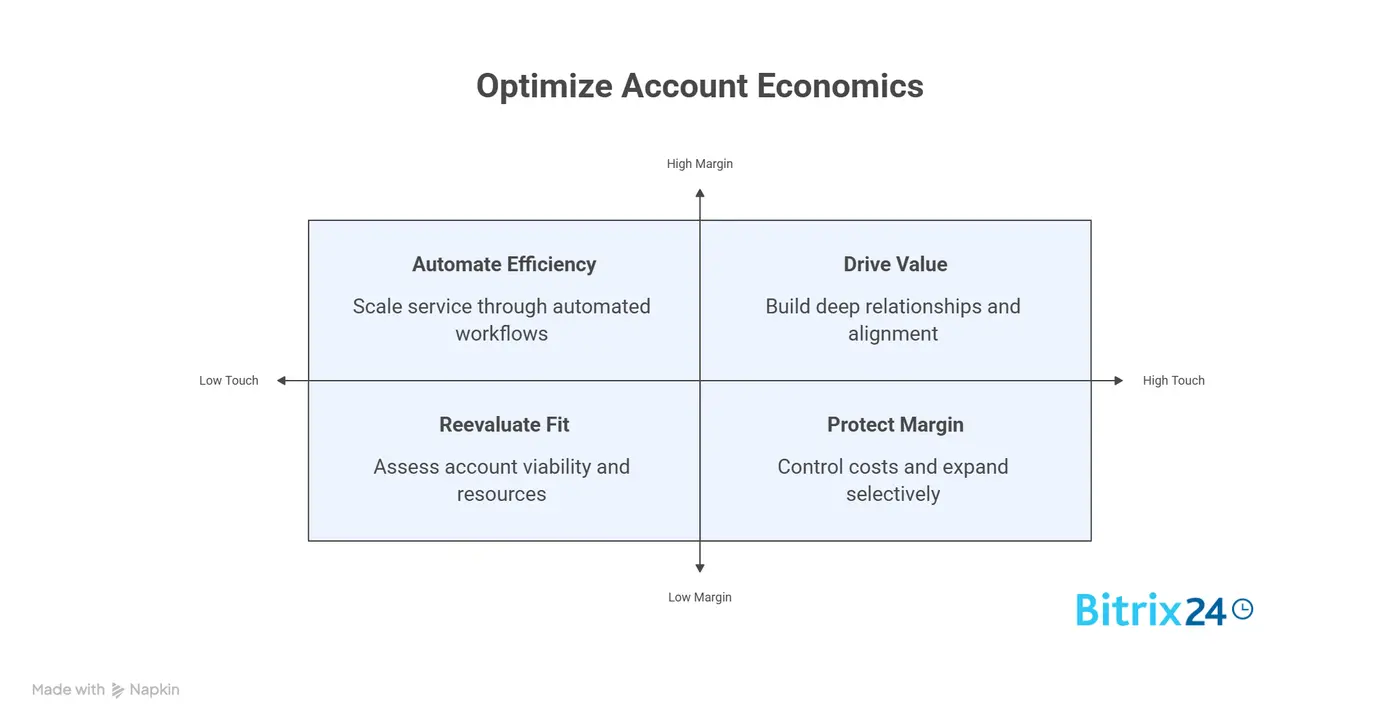
Businesses with mixed customer types benefit from segment-based retention models. Some accounts need automated onboarding, standardized education, and light commercial oversight. Others need strategic consultation and tighter renewal planning. A third group needs commercial restructuring because the current service pattern is simply too expensive to sustain.
All three cases point to the same idea: retention works best when the model matches the economics of the account, not the size of the logo or the urgency of the renewal date.

Scaling retention programs: Operational impact, trade-offs, and limits
Margin-focused retention doesn't scale on good intentions. It needs operating discipline across segmentation, coverage models, renewal ownership, health measurement, and reporting that finance can actually use. When those systems are inconsistent, teams drift back toward reactive account management.
Segmentation comes first
Without it, every account becomes a special case. Once segments are clear, coverage gets rational: strategic accounts get deeper engagement, growth accounts get targeted programs, and lower-value accounts get scalable support paths. This is usually RevOps or CS-ops work, set once and revisited each quarter as accounts move between tiers.
Trade-offs between high-touch and automated
High-touch retention can lift satisfaction and rescue complex renewals, but it's expensive and hard to scale. Automated programs cut cost-to-serve and create consistency, yet they miss subtle risk signals in accounts where buying involves politics, change management, or multi-stakeholder friction. So most companies need a mixed model. Some accounts warrant a named person and a custom plan; others run fine on automated journeys.
The operating challenge is deciding where human intervention changes the economics enough to justify the cost.
Knowing the limit
Not every customer should be retained at any cost. A simple four-way decision framework keeps the program honest:
- Grow the account when fit, adoption, and margin profile are all strong.
- Reprice when the value is real but commercial terms are weak.
- Redesign the service model when retention is possible but delivery costs are too high.
- Let it churn when the account consistently destroys value and shows little path to improvement.
That last line sounds blunt (almost counter-intuitive), but it's much healthier than running a retention program that protects revenue while eroding the business underneath it.
FAQ: Practical questions about maximizing margin ROI through retention
How should sales and customer success prioritize accounts when high-revenue customers also carry high support costs or weak margins?
Don't rank accounts by revenue alone. Use a two-part view: growth potential and economic quality. A large account with a heavy support burden may still deserve investment if there's a realistic path to better adoption, repricing, or operational simplification. If no such path exists, it shouldn't automatically outrank a smaller customer with better expansion fit and cleaner margins.
What should teams do when a customer will renew only with discounts, custom terms, or service exceptions that reduce profitability?
Separate temporary negotiation pressure from structural account weakness. If the customer sees clear value and the concession is contained, a tactical compromise can make sense. But if renewal depends on repeated exceptions, treat that as a signal that the account model is broken. The real options become repricing, service redesign, narrower scope, or accepting churn. Anything else just locks in poor economics for another term.
How can a business increase LTV when customers are retained but adoption stays shallow, expansion stalls, or usage doesn't translate into margin?
Retention without value expansion is a warning sign. The priority is diagnosing where the value path fails, not adding more touchpoints. Maybe onboarding never connected to a meaningful outcome. Maybe the wrong stakeholders were activated. Maybe the tier doesn't match the use case. Maybe usage is broad but commercially weak because customers cluster in low-margin features or support-heavy workflows.
LTV improves when teams fix that underlying value design rather than pushing for a larger contract.
Grow Retention Without Draining Margins
Bitrix24 unites CRM, tasks, automation, and reports so teams spot profitable accounts, control service costs, and renew smarter.
Learn MoreTurn retention into profitable growth
Retention gets stronger when teams stop treating every renewal as equally valuable. The real goal is to keep and grow the accounts that improve lifetime value, protect margin, and justify the cost of serving them.
That takes clear account data, disciplined segmentation, smart renewal handling, and a shared view of where customer success effort actually changes the number. Without that, teams can stay busy saving revenue while quietly weakening profitability.
Bitrix24 gives sales and customer success teams one place to manage customer records, deals, tasks, communication, automation, and reporting, so retention work stays connected to account value instead of scattered across disconnected tools.
Start for free and build a retention system that helps your team grow the right accounts, protect margin, and focus effort where it pays off.