The Founder’s First CRM: What to Track Before Revenue Operations Exists


Short answer: before you have RevOps, your CRM only needs to answer five questions on every active deal: where it came from, who owns it, what happens next, what it's worth, and what could derail it. If those fields are current, sales gets a lot more repeatable fast.
Leads are coming in, demos are happening, someone's "following up." But the whole motion runs on the founder's memory, and memory doesn't scale. Nobody can say with confidence what'll close or why deals stall.
You don't fix that with a heavier CRM. You fix it with a small one that answers five questions on every active deal: where it came from, who owns it, what happens next, what it's worth, and what could derail it.
Keep those current and selling gets repeatable fast — no enterprise complexity, just five fields, clear rules, and a weekly rhythm that keeps the data trustworthy.
This article will show you how.
What a founder's first CRM should do
A founder's first CRM should be one place where active deals live, each deal has a clear owner, and the next action's visible. That's it. You don't need layered reporting, territory design, advanced routing logic, or a library of dashboards.
What you do need is basic discipline. A small set of fields captured the same way every time so the team can answer simple questions:
- Which deals need action this week?
- Which source is creating qualified opportunities?
- Who's responsible for this account?
- How much pipeline is actually credible?
Support selling, not compete with it
If updating the system feels like separate admin work, people will avoid it. If it helps reps and founders know what to do next, it'll get used.
As CRM expert Ali Hajimohamadi notes, "The best early CRM is the one your team trusts enough to use before every pipeline review."
So, keep the standard simple: every active deal should have current ownership, a dated next step, a realistic value, a defined source, and a visible risk signal. That's enough to run the business at this stage.
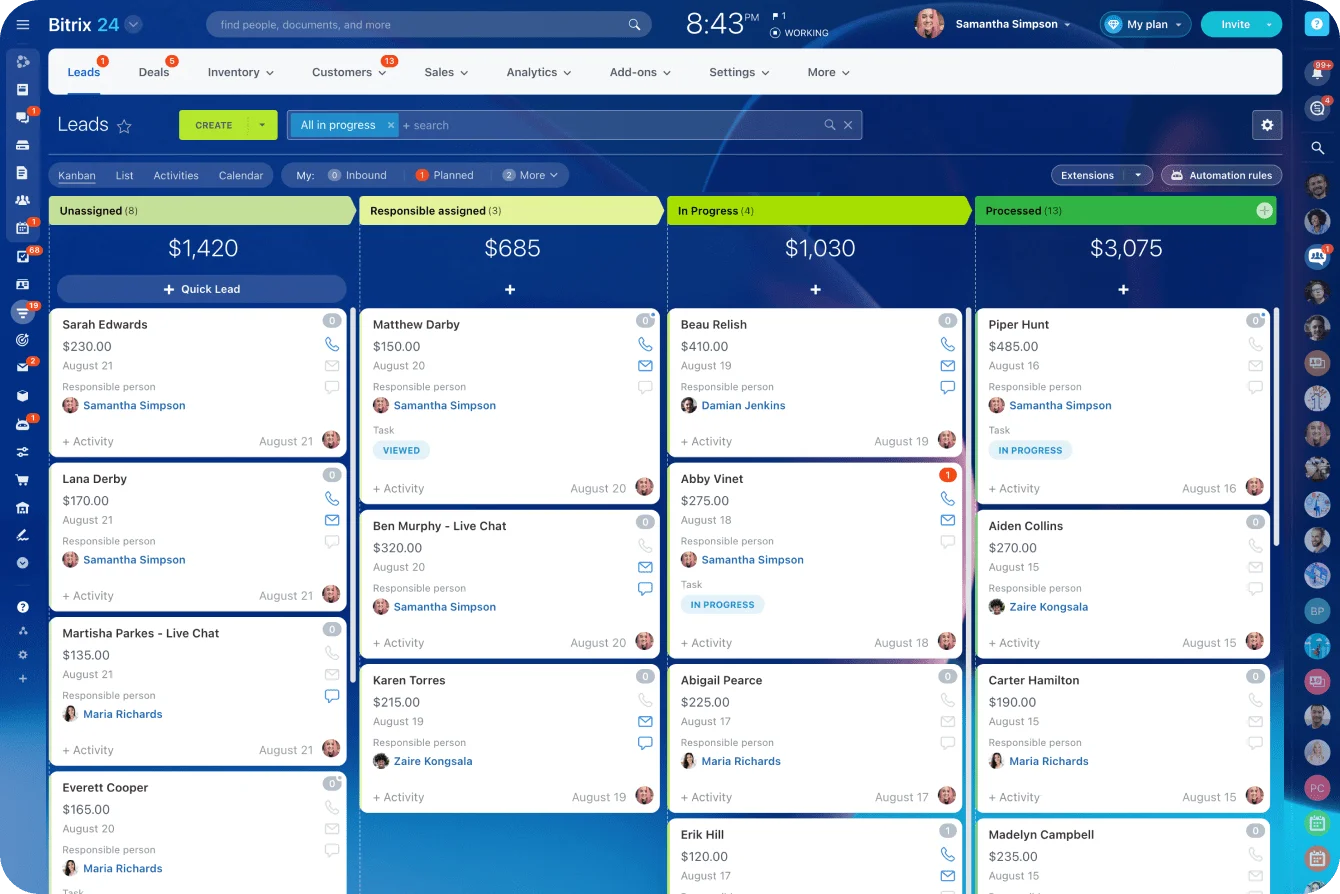
Tools like Bitrix24's CRM can help early teams move from founder memory to shared sales records without overwhelming the process.
Why CRM processes break in early-stage teams
Most early CRM breakdowns come from good intentions. Founders optimize for speed, so they use whatever's fastest: email, notes apps, calendar invites, text messages, Slack.
That works when one person's carrying the whole sales motion. It fails as soon as others need shared visibility.
Example-in-action: A founder closes a pilot deal through texts and a Google Doc. Three months later, a new sales hire asks for the pricing history. Nobody can find it. The renewal conversation stalls because the contract terms are scattered across four threads.
The overbuilding trap
The second failure mode is overbuilding too early. A team buys a real CRM, then adds twenty fields, eight stages, custom automations, lead scores, and reporting views. It looks impressive for a week. After that, no one updates it because the process is heavier than the selling motion itself.
The definition trap
The third issue is inconsistent definitions. One person marks "Outbound" as a source. Another writes "cold email." A third logs "Founder network" for the same kind of intro. Once that happens, the data stops being usable. Reports are noisy. Reviews get bogged down in interpretation. In fact, poor data quality is responsible for an average of $15 million per year in losses.
The fix is to build a very small system with rules simple enough that people will actually follow them.
Founder CRM Starter Pack: Fields, Stages, Automation Rules
Enter your email address to get a comprehensive, step-by-step guide

Step 1: Start with the five fields that matter most
If you're building a first CRM, start with only five fields on every active deal:
- Lead source — where the opportunity came from
- Next step — the specific action that moves the deal forward
- Owner — the one person accountable for progress
- Value — the current expected commercial value of the deal
- Risk — the main reason the deal may stall or not close
Why these five
Each field has a clear job. Lead source supports attribution. Next step drives action. Owner creates accountability. Value supports basic forecasting. Risk shows deal health.
This is the minimum viable operating data set. It doesn't try to capture every detail of discovery, implementation, or product fit. It gives you enough structure to run the pipeline without turning the CRM into a burden.
Required fields should stay minimal for one reason: if your team needs too many updates to save a deal, they'll stop updating the record. A simple rule's better than a perfect schema nobody maintains.
|
Field |
Why it matters |
|---|---|
|
Lead source |
Shows which channels create real pipeline |
|
Next step |
Keeps follow-up concrete and time-bound |
|
Owner |
Prevents drift and duplicate outreach |
|
Value |
Creates a basic, usable revenue view |
|
Risk |
Flags trouble before a deal quietly dies |

Step 2: Define exactly how each field should be used
The fields themselves aren't enough. You need simple usage rules so everyone logs data the same way from day one.
Ownership: one person only
Every deal should have one owner only. Others can support, join calls, or advise, but one person's accountable for moving it. Shared ownership sounds collaborative. In practice, it creates hesitation and dropped follow-up.
Next step: dated actions only
Next step should always be one dated action. Not "follow up soon." Not "waiting." A good next step names the action and the date:
- "Send security FAQ by May 9"
- "Champion to confirm legal review kickoff on May 12"
- "Pricing call scheduled for May 15 at 2pm"
If there's no dated next step, the deal's drifting.
Lead source: controlled lists
Lead source needs a controlled list of allowed values. Keep it short and specific:
- Founder network
- Investor intro
- Outbound email
- Paid search
- Organic inbound
- Partner referral
- Customer referral
Value: one standard definition
Value also needs a standard definition. Pick one. For most early teams, the cleanest choice is expected first-year contract value. That avoids mixing pilot revenue, multi-year upside, and expansion hopes into one number.
Risk: standardized labels
Risk shouldn't be free text if you want patterns later. Use a short picklist:
- Budget
- Authority
- Timing
- Competition
- Product gap
- Procurement
- No active champion
You can still add a note, but the core label should be standardized. Examples help a lot. "Source: Investor intro" is good. "Source: warm" isn't. "Risk: procurement" is good. "Risk: feels slow" isn't.
Step 3: Build a simple pipeline around action, not reporting
Once the fields are defined, build a small pipeline that reflects real deal movement. Keep stage count low. If your early CRM has too many stages, people start using them as vague mood labels instead of markers of progress.
A practical early-stage pipeline might look like this:
- New — identified but not yet qualified
- Qualified — basic fit confirmed
- Meeting booked — a live conversation's scheduled
- Solution discussed — use case and fit reviewed
- Proposal sent — commercial terms shared
- Review — legal, security, or procurement in motion
- Closed won / Closed lost
Test: what changed in the real world?
The important part isn't the exact labels. It's the rule behind them. A deal should only move stages when there's evidence:
- A meeting's actually booked
- A proposal was actually sent
- A security review actually started
That keeps the pipeline tied to buyer behavior, not internal optimism. Useful test: if you can't explain what changed in the real world when a deal moved stages, the stage's probably too vague.
Serve execution first
This approach stops the CRM from becoming a reporting prop. Early teams often create stages because they sound useful in a board deck. But if stages don't map to real actions, they tell you very little about what has to happen next.
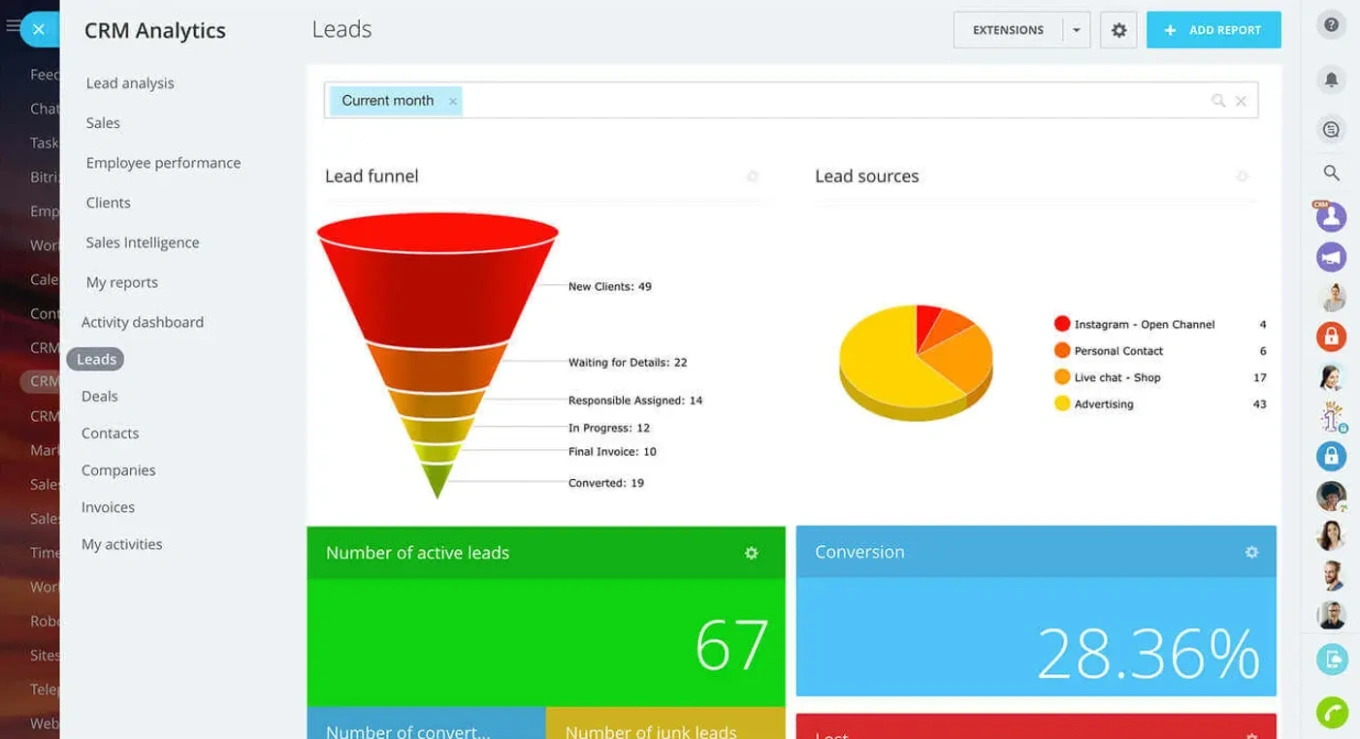
Using Bitrix24's pipeline visualization can help here, as it forces you to define concrete stage transitions based on actual deal activity rather than abstractions.
Step 4: Create a weekly operating rhythm to keep data current
Even a simple CRM decays fast without a regular operating rhythm. The easiest fix is a short weekly pipeline review. Not a long sales meeting. Just a focused pass through every active deal using the five core fields.
In that review, ask the same questions each time:
- Is the next step specific and dated?
- Is the owner clearly accountable?
- Does the value still look realistic?
- Is the risk visible and current?
- Is the source logged correctly?
What happens in the meeting
This meeting's where stale records get fixed:
- If a next step's overdue, replace it with a new one or close the deal out
- If ownership's unclear, assign one person on the spot
- If the value's inflated relative to what the buyer has actually discussed, adjust it now
- If a risk's obvious but not logged, make it visible
Building CRM discipline
Done well, this review changes the culture around CRM use. The system stops being a database people update "when they get a minute." It becomes part of how selling happens. People know that fuzzy records will be exposed quickly, so they keep them current.
Keep the cadence tight and practical. Early teams usually need 20 to 30 minutes once a week. That's enough to protect data quality without turning pipeline management into a ceremony.
Summary: A good weekly review isn't about reading dashboards out loud. It's about making sure every active deal has a clear action, owner, value, and risk right now.
Step 5: Avoid the mistakes that make early CRM data useless
A few predictable mistakes can ruin early CRM data even when the team means well:
- Missing next steps — the deal has activity history but no clear future action
- Shared ownership — multiple people are involved, so no one feels fully responsible
- Inflated values — upside scenarios get logged as if they're committed scope
- Vague sources — entries like "network" or "marketing" hide what actually worked
- Hidden risks — obvious blockers stay in call notes instead of the record
How each one breaks decisions
Each mistake distorts decisions in a different way:
- Missing next steps kill follow-up speed
- Shared ownership causes duplicate outreach and dropped balls
- Inflated values make forecasts look healthier than they are
- Vague sources block channel learning
- Hidden risks create fake confidence until a deal suddenly disappears
Practical fixes
The fixes aren't complicated:
- Make next step date fields mandatory
- Use picklists instead of open text for source and risk
- Set basic aging alerts so deals with no update in a set number of days get reviewed
- Require one owner at the record level, even if several people touch the account
- Define value in one sentence so everyone uses the same number logic
One more practical move: if a deal repeatedly lacks a next step, downgrade it or close it. Early teams often keep inactive deals around because the logo looks nice in pipeline. That clutters reviews and makes the whole system less trustworthy.
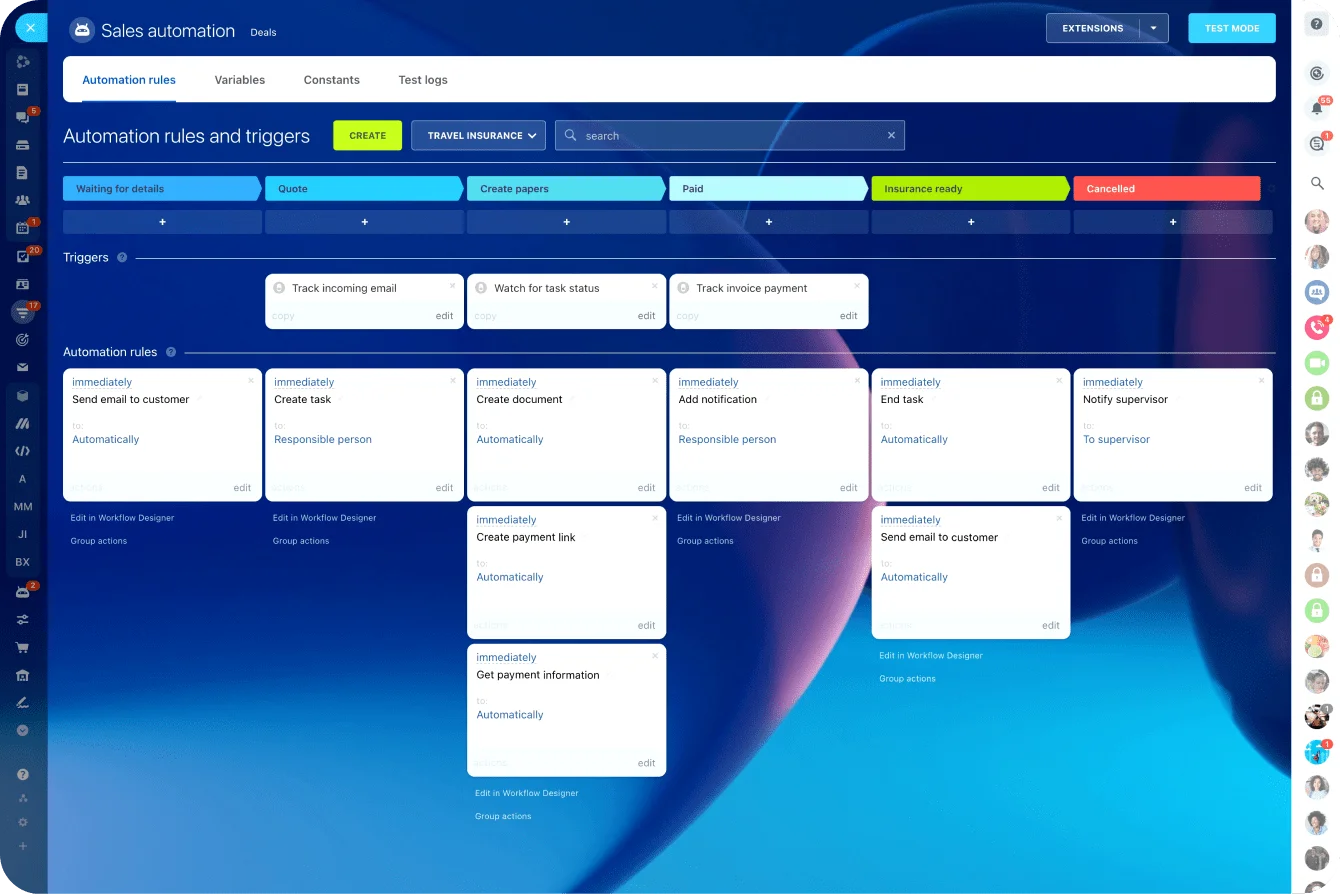
Clean data's less about strictness for its own sake and more about preserving signal. If the CRM can't help you act, forecast, or learn, then it's just storage. Using features like Bitrix24's task automation tools can help enforce these basic hygiene rules without adding manual overhead.
Step 6: Make the system reliable now and easier to scale later
The best time to prepare for future RevOps is before you hire RevOps. Not by building a complex stack, but by documenting the basics while they're still manageable. Write down your field definitions, pipeline stage rules, and weekly review cadence in one short shared document.
This documentation does two things:
- Keeps the current team aligned
- Makes future handoff much easier when an operations hire joins
When an operations hire joins later, they can improve a functioning system instead of reverse-engineering years of inconsistent habits.
What reliability looks like early
Reliability at this stage is simple and visible:
- Active deals have current next steps
- Owners are clear
- Source data's usable enough to compare channels
- Risk flags are present before deals stall
You don't need perfect completeness. You need enough consistency that the CRM reflects what's actually happening.
Why this reduces future pain
That consistency reduces rebuild pain later. Teams with clean early data migrate more easily, redesign stages faster, and keep historical reporting intact. Teams without it often spend weeks cleaning records, merging categories, and guessing what old fields meant.
Research backs this up: organizations report up to a 66% increase in revenue with clean, enriched data. But that benefit only compounds if you establish good habits early, when your data set's still small enough to control.
Start before you need to
None of this requires a RevOps hire, a big budget, or a complex stack. Five fields, one owner per deal, dated next steps, and a 20-minute weekly review. That's a system a founder can run today and an operations lead can build on later, instead of reverse-engineering years of inconsistent habits.
If you do only one thing after reading this, do this: make the five fields mandatory on every active deal and review them weekly.
The reward is a sales motion that doesn't depend on you remembering every conversation.
Keep early sales deals clear and accountable
Bitrix24 gives founders a simple CRM to track sources, owners, next steps, deal value, and risks before RevOps complexity.
Learn MoreFAQ
Do we need a specific CRM tool?
Not really. At this stage, tool choice matters less than consistent use. Pick something simple that your team will actually update. Bitrix24's free plan works well for early teams because it includes the core CRM features without forcing you into enterprise complexity you don't need yet.
When should we migrate to a more structured setup?
Usually when multiple sellers, handoffs, or channel volume make manual judgment too fragile. If weekly reviews are exposing repeated process gaps, that's a sign you're ready for more structure.
What if the founder still owns most deals?
That's common. The rule still holds: each deal needs one clear owner and one visible next step. Founder-led sales is exactly where hidden context tends to pile up.
How clean does the data need to be before hiring RevOps?
Clean enough that definitions are clear and the five fields are mostly reliable. A future ops lead can optimize from there. They can't fix what was never defined.
Will this reduce future CRM rebuilds?
Yes. Clean source categories, ownership rules, value definitions, and stage logic make later redesigns much less painful. You're building on a foundation instead of starting from chaos.